Industrial Flour Mill Plant Solution for Large-Scale Grain Processing
An industrial flour mill plant is built for continuous production, not occasional small-batch milling. The project must handle raw grain supply, cleaning, milling, packing, storage, power, dust control and daily operation as one system.
For large-scale grain processing, equipment capacity alone does not decide whether a project will succeed. A plant with strong machines can still face problems if raw grain supply is unstable, packing speed is too slow, the workshop layout blocks material flow, or operators cannot manage the process.
This guide explains how buyers should plan an industrial flour mill plant solution for maize, wheat and multi-grain processing projects.
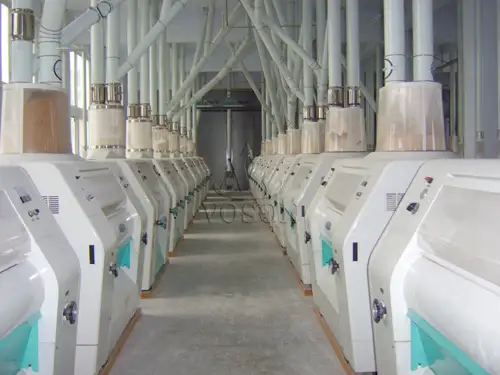

Industrial Projects Start With Business Conditions
Before discussing machine models, buyers should understand the business conditions behind the project. Industrial plants need enough raw grain, enough market demand and enough operating capacity to justify the investment.
A supplier can design equipment, but the buyer must confirm whether the project has real production and sales support.
- How much maize or wheat can the buyer purchase every month?
- How many days per month will the plant operate?
- Can the local market absorb the planned flour output?
- Does the buyer sell through distributors, factories or retail channels?
- Can the warehouse handle raw grain and finished products?
- Will the project expand after the first stage?
When these answers stay unclear, a large capacity plant may create pressure instead of profit.
Match Capacity With Raw Grain and Market Demand
Industrial flour mill plant capacity should come from calculation, not only ambition. A 100T, 200T, 300T or 500T plant needs different raw grain supply, power, labor, packing and storage arrangements.
Large capacity makes sense only when the buyer can feed the plant and sell the output steadily.
| Planning Factor | Why It Matters |
|---|---|
| Raw grain supply | The plant cannot run at full capacity without stable maize or wheat supply. |
| Market demand | Finished flour needs reliable sales channels. |
| Operating days | Real monthly output depends on actual running time. |
| Packing speed | Slow packing can limit the whole production line. |
| Warehouse space | Raw grain and finished product storage must support daily turnover. |
A practical industrial solution should balance capacity, sales and operation, rather than simply choose the largest possible line.
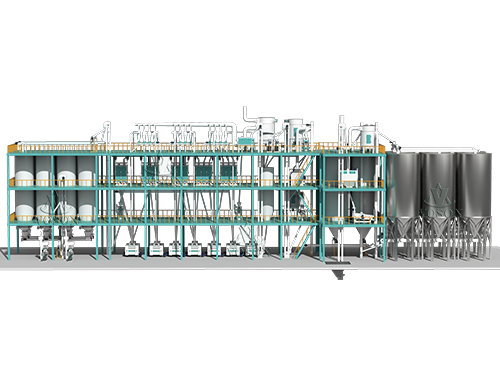
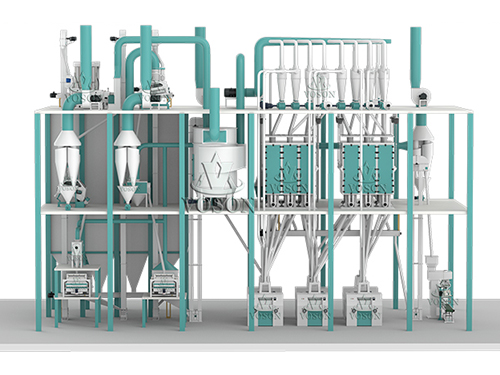
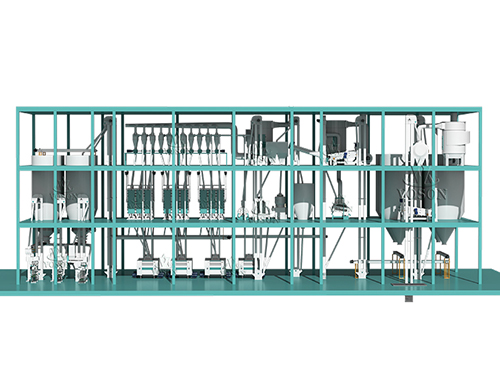
Design the Process Around the Final Product
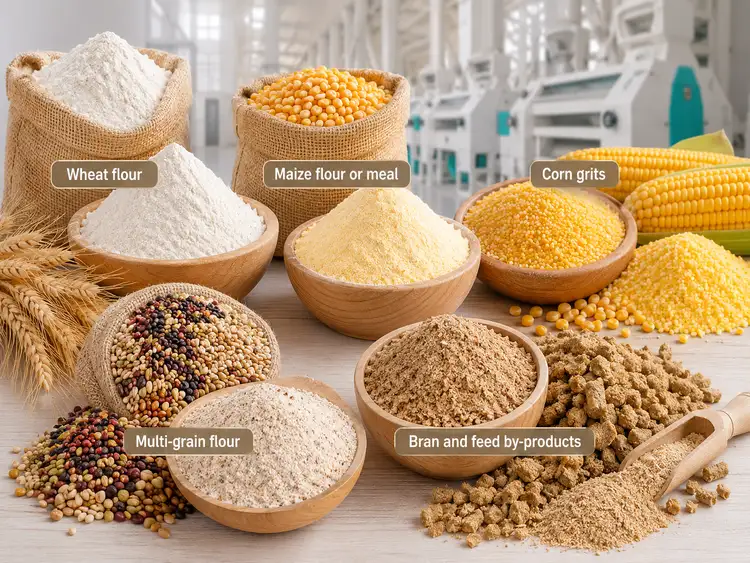
Industrial grain processing should start from the final product. Wheat flour, maize flour, maize meal, corn grits and multi-grain flour all require different process planning.
A supplier should explain how the process supports the target product quality and local market demand.
| Product Direction | Process Focus |
|---|---|
| Wheat flour | Cleaning, conditioning, roller milling, plansifter separation and bran handling. |
| Maize flour | Cleaning, peeling or degermination, milling, sifting and packing. |
| Corn grits | Degermination, particle size grading and separate product classification. |
| Multi-grain products | Flexible cleaning, process adjustment and product changeover planning. |
If a supplier uses the same process for every project, the final product may not match the market.
Cleaning and Preparation Decide Plant Stability
Industrial plants run longer hours and process more grain, so cleaning and preparation become more important. Poor cleaning can damage machines, reduce product quality and increase downtime.
The cleaning section should match the milling section. If cleaning capacity falls behind, the whole plant slows down.
- Remove stones, dust, light impurities and metal before milling.
- Protect roller mills, maize milling machines and conveying equipment.
- Improve food safety and final product quality.
- Prepare wheat with proper dampening and conditioning.
- Prepare maize with peeling or degermination when the product requires it.
For industrial projects, buyers should not treat cleaning as a small accessory. It protects the whole line.
Milling, Sifting and Packing Must Stay Balanced
A large flour mill plant works well only when each section matches the next one. Strong milling machines cannot solve a weak sifting system. High milling output also loses value if packing cannot keep up.
Buyers should ask the supplier how the line balances capacity between major sections.
- Cleaning capacity should support continuous feeding.
- Milling capacity should match the target output and product type.
- Sifting or grading should separate flour, bran, grits or intermediate products correctly.
- Packing machines should handle the planned daily output.
- By-products need storage or packing routes.
Industrial design is not about choosing the strongest single machine. It is about avoiding bottlenecks across the whole plant.
Automation Should Serve Operation, Not Decoration
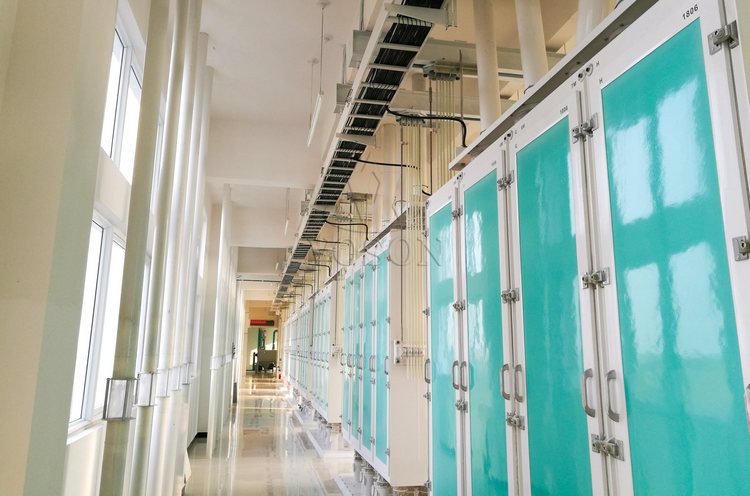
Automation can help large plants run more steadily, but it should match the real operation team and budget. Buyers should choose automation because it solves management problems, not because it sounds advanced.
A larger plant may benefit from centralized control, motor protection, alarms and clearer operation monitoring. Smaller industrial projects may need a simpler control system that operators can manage easily.
| Control Level | Suitable Situation |
|---|---|
| Basic control | The plant has a simpler process and a limited budget. |
| Centralized control | Operators need to manage several production sections from one control area. |
| PLC control | The project needs better monitoring, alarms and process management. |
The best control system is the one the buyer can operate, maintain and use every day.
Layout and Logistics Affect Daily Profit
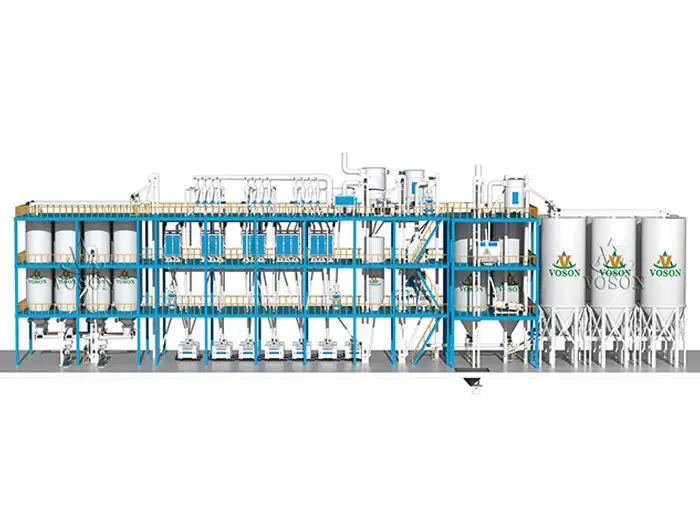
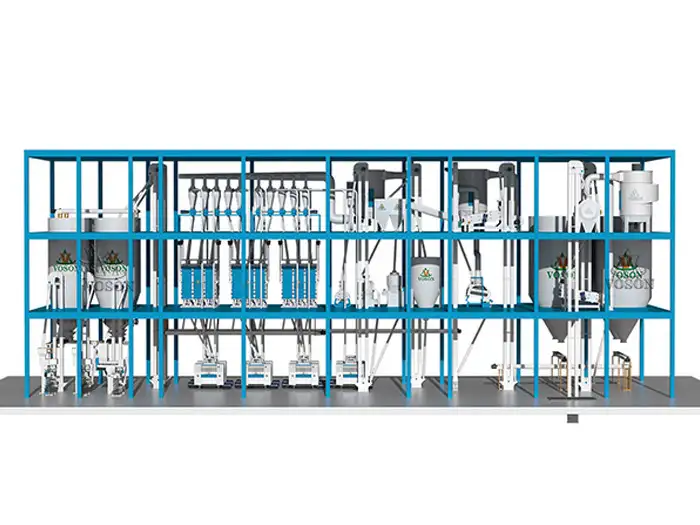
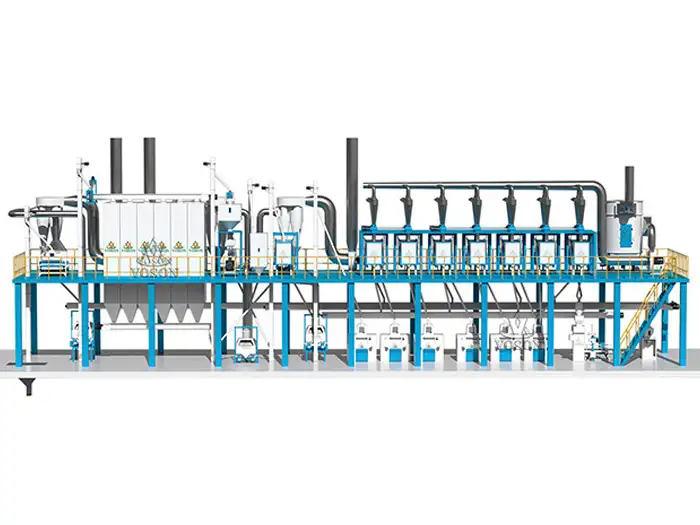
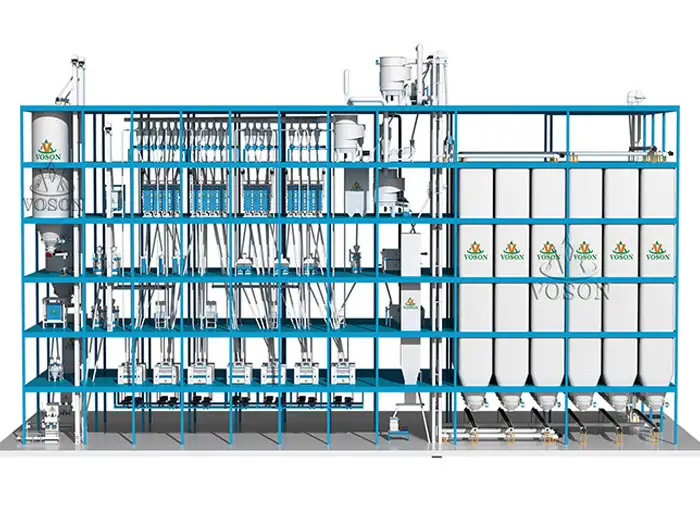
Industrial flour mill plant layout affects more than installation. It also affects daily labor, truck movement, packing speed, warehouse turnover and maintenance time.
A good layout should let raw grain, intermediate material, finished products and by-products move smoothly.
- Raw grain unloading and storage area
- Feeding route from storage to cleaning section
- Cleaning, milling and sifting workshop arrangement
- Finished flour packing area
- Warehouse and truck loading route
- Maintenance space around major machines
- Electrical room or control area
- Reserved space for future expansion
When layout planning ignores logistics, the plant may spend more labor and time moving materials than necessary.
Plan Dust Collection and Workshop Safety Early
Large-scale milling creates dust in cleaning, conveying, milling, sifting and packing sections. Dust collection helps protect the workshop environment and reduce material loss.
Buyers should discuss dust collection during process design, not after installation begins.
- Identify dust points in each process section.
- Arrange fans, ducts, cyclones or dust collectors properly.
- Keep packing and operation areas cleaner.
- Reduce flour loss in transfer points.
- Support safer and more comfortable working conditions.
A clean industrial plant is easier to operate and maintain over the long term.
Industrial Project Checklist Before Ordering
Before confirming an industrial flour mill plant solution, buyers should review the project as a complete operation system.
- Raw grain supply can support the selected capacity.
- Market demand can absorb planned output.
- Process design matches the final product.
- Cleaning, milling, sifting and packing capacities stay balanced.
- Layout supports raw grain, finished product and truck movement.
- Automation level matches operator ability.
- Dust collection and electrical control are included.
- Spare parts and maintenance support are planned.
- Installation and commissioning responsibilities are clear.
This checklist helps buyers avoid choosing equipment without planning the real operation behind it.
Conclusion
An industrial flour mill plant solution should match business demand, raw grain supply, final product, process design, automation, layout, packing, storage and long-term maintenance. A large plant needs system planning more than a simple machine list.
For overseas buyers, the safest project starts with clear communication: what the plant will process, what it will produce, how much it will run, how products will be packed and how the factory will operate every day.
Voson provides industrial flour milling solutions for maize, wheat and multi-grain projects, including process design, equipment configuration, plant layout and installation guidance. You can view our flour milling equipment and flour mill plant projects for reference. You can also contact Voson to discuss a large-scale flour mill plant solution.
FAQ
What is an industrial flour mill plant?
It is a complete grain milling production system designed for continuous commercial operation, stable product quality and higher output.
How do I choose the right capacity?
Choose capacity according to raw grain supply, market demand, operating days, packing speed, warehouse space and investment budget.
Why is process design important?
Process design connects cleaning, preparation, milling, sifting and packing into one stable production flow.
Does every industrial plant need PLC control?
No. PLC control helps larger projects, but buyers should choose the control level according to capacity, budget and operator ability.