Stainless Steel Mixer for Flour and Dry Powder Blending
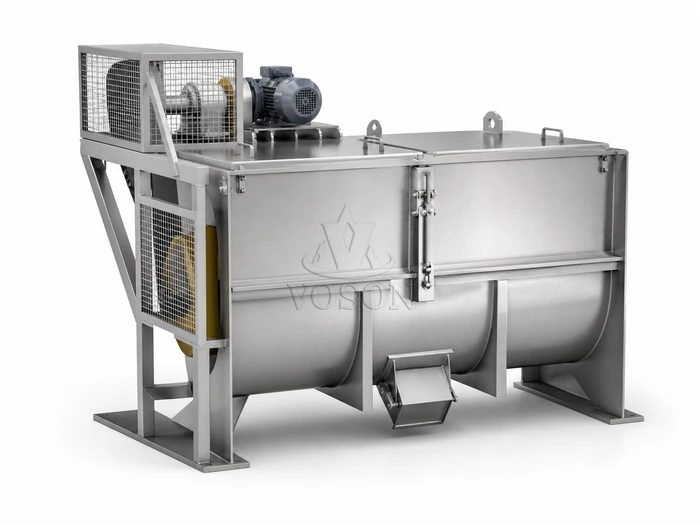
The Voson Stainless Steel Mixer is a horizontal batch mixer designed for the uniform blending of flour, starch, premixes, food ingredients and other suitable dry powders. Counter-directional ribbon elements move material both radially and along the mixing chamber, helping distribute components throughout the batch within a compact U-shaped trough.
The mixer can connect with storage bins, dosing equipment, stainless steel screw conveyors and a flour packing machine. Batch volume, working capacity, ribbon geometry, discharge arrangement, motor and surface finish are selected for the actual recipe and production process rather than from one universal specification.
Item
Available Configuration
Mixer type
Horizontal batch mixer with ribbon mixing elements
Customized; confirmed from batch weight, bulk density and recommended fill level
Product-contact construction
Stainless steel; grade, thickness and surface finish confirmed before manufacture
Feeding
Manual, conveyor-fed or integrated with weighing and dosing equipment
Discharge
Bottom or side discharge arrangement according to the process layout
Controls
Local control, timer, variable-frequency drive and line interlocks as required
The table describes available configurations, not fixed performance values. Final capacity, motor power and mixing time depend on material bulk density, particle size, flowability, moisture, formulation, batch size and required mixing result. A representative material sample or complete material data sheet is recommended before final selection.
How a Stainless Steel Ribbon Mixer Works
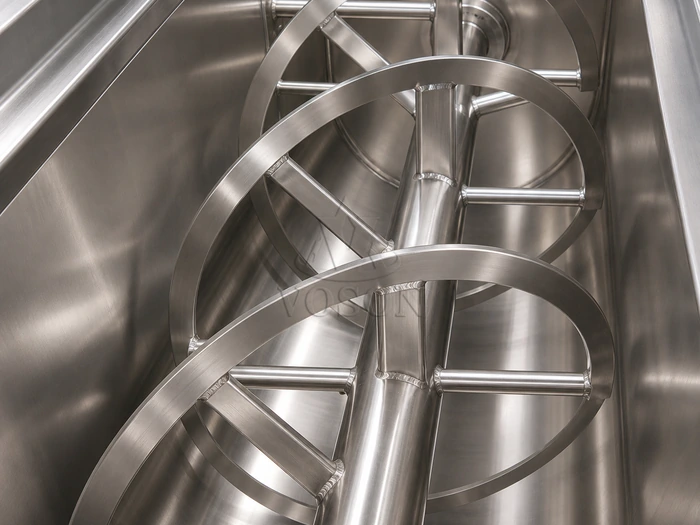
A horizontal shaft rotates inside the U-shaped mixing trough. Inner and outer ribbon elements are arranged to move material in different axial directions while also lifting, folding and circulating the powder across the chamber. These overlapping movements reduce stagnant zones and repeatedly bring ingredients into contact.
A normal batch follows four stages: ingredients are weighed and loaded, the mixer runs for the validated blending time, the drive stops or follows the selected discharge sequence, and the blended material leaves through the outlet. The upstream dosing accuracy and the downstream discharge rate both affect the consistency of the complete process.
The internal image shows the horizontal shaft and helical ribbon arrangement. Ribbon pitch, clearance and rotational speed must match the material. Very fine powders, fragile inclusions, high-fat formulas, sticky materials or recipes containing liquids may require a different agitator, spray system, sealing arrangement or operating procedure.
Main Features
Multi-directional powder movement: Inner and outer ribbons circulate material through the horizontal chamber to support consistent batch blending.
Stainless steel contact surfaces: The trough, shaft, ribbons and other agreed product-contact parts can be manufactured in stainless steel for corrosion resistance and easier cleaning.
Enclosed batch chamber: Fitted covers help limit dust escape and external contamination during mixing.
Controlled discharge: The outlet can be positioned and sized to match the receiving bin, conveyor or packing system.
Process integration: The mixer can work with weighing, dosing, conveying and packing equipment in a complete flour or dry-powder line.
Maintenance access: Covers and access points can be configured for inspection and cleaning while guards protect the drive area during operation.
Customized controls: Timing, speed control, sequencing and interlocks can be selected according to the production line.
Stainless steel construction is project-specific. Unless explicitly stated in the quotation, stainless steel product-contact parts do not mean that the motor, gearbox, guards, frame and every external component are also stainless steel.
Applications in Flour and Food Powder Processing
The stainless steel mixer is intended for suitable dry or low-moisture materials whose flow and particle characteristics are compatible with ribbon mixing. Typical applications include:
Maize flour and wheat flour blends
Starch and modified flour formulations
Multigrain flour and cereal premixes
Bakery, seasoning and food-ingredient powders
Vitamin, mineral or functional premixes when the validated addition rate is suitable
Feed ingredients and other compatible dry powder formulations
Suitability should be confirmed before ordering. Material safety, dust explosibility, allergen control, sanitation requirements and cross-contamination risks can change the required motor, electrical components, seals, finishes and cleaning method.
Ribbon Mixer vs Paddle Mixer vs Vertical Mixer
Mixer Type
Typical Strength
Selection Consideration
Horizontal ribbon mixer
Thorough circulation of many free-flowing dry powders in batch production
Requires appropriate fill level, ribbon clearance and discharge design
Horizontal paddle mixer
Gentler lifting and shorter mixing cycles for some fragile or varied-density materials
Paddle geometry and speed must be validated for the recipe
Vertical mixer
Compact footprint and simple batch handling for some powders or feed ingredients
Mixing time, residue and discharge behavior differ from horizontal designs
No mixer type is best for every formulation. Voson selects the chamber and mixing element from the material properties, required batch size, allowable breakage, cleaning method and target process result.
Reference Selection Parameters
Because confirmed model, capacity and motor-power data are not available for this project, Voson uses the following information to prepare a technical proposal. These are selection inputs, not guaranteed machine parameters.
Selection Input
Why It Matters
Material names and formulation
Determines compatibility, mixing mechanism and contamination-control requirements
Bulk density of each ingredient
Converts batch weight into working volume and influences motor demand
Target batch weight and batches per hour
Defines chamber size, cycle time and upstream/downstream flow
Particle size and flowability
Affects segregation risk, ribbon geometry, residue and discharge behavior
Moisture, oil or liquid addition
May require spray equipment, different seals or another mixer design
Target mixing result and test method
Provides the acceptance basis for mixing time and uniformity
Cleaning and allergen requirements
Influences access, surface finish, seals and discharge design
Plant voltage, frequency and layout
Determines electrical selection, drive arrangement and connection dimensions
Actual usable batch volume is lower than the empty chamber volume. The correct fill level is determined from the ribbon geometry and material behavior; overfilling or underfilling can reduce circulation and mixing performance.
Selection and Customization
A complete proposal should cover more than the mixer body. Feeding accuracy, ingredient sequence, discharge time, transfer route and packing rate determine whether the line can achieve the required batches per hour. Voson can coordinate the mixer with bins, weighing devices, conveyors and packing equipment to reduce bottlenecks between process stages.
Available project options can include stainless steel grades and finishes, multiple feeding ports, dust-control connections, inspection covers, safety interlocks, liquid-addition equipment, discharge valves, supporting frames, load-cell weighing, variable-frequency control and customized electrical panels. Option availability is confirmed from the material and local standards.
Frequently Asked Questions
What materials can the stainless steel mixer handle?
It is commonly selected for compatible dry powders such as maize flour, wheat flour, starch, premixes and food ingredients. Final suitability depends on flowability, moisture, particle size, abrasiveness, fragility and formulation.
How is mixer capacity selected?
Capacity is selected from the required batch weight, material bulk density and recommended working fill level. Empty chamber volume should not be treated as usable batch volume.
How long does one mixing cycle take?
There is no universal mixing time. It must be validated for the specific recipe, fill level, loading sequence, ribbon speed and required test result. Feeding and discharge time must also be included when calculating batches per hour.
Can liquid be added during mixing?
Limited liquid addition may be possible with a properly designed spray system and validated recipe. High liquid content or sticky material can require a different mixing element, drive, seal or cleaning design.
Is the complete machine made of stainless steel?
The stainless steel grade and construction scope are defined in the quotation. Product-contact parts can be stainless steel while the motor, gearbox, guard or support frame may use other materials unless full stainless steel construction is specified.
What information is needed for a quotation?
Please provide material names, formulation or addition ratios, bulk density, batch weight, required batches per hour, moisture, particle size, target mixing result, cleaning requirements, plant voltage and equipment layout.
Customized Mixing Equipment from Voson
Voson supplies customized stainless steel mixing equipment for maize flour, wheat flour, starch, premixes and suitable dry-powder processing lines. Send your material data, batch requirement and plant layout to receive a configuration covering the mixer, feeding, conveying, discharge and packing connections.
We receive enquiries in English, Español (Spanish), Русский язык (Russian), Français (French) and العربية (Arabic). Our professional team will reply to you within one day. Please feel free to contact us!