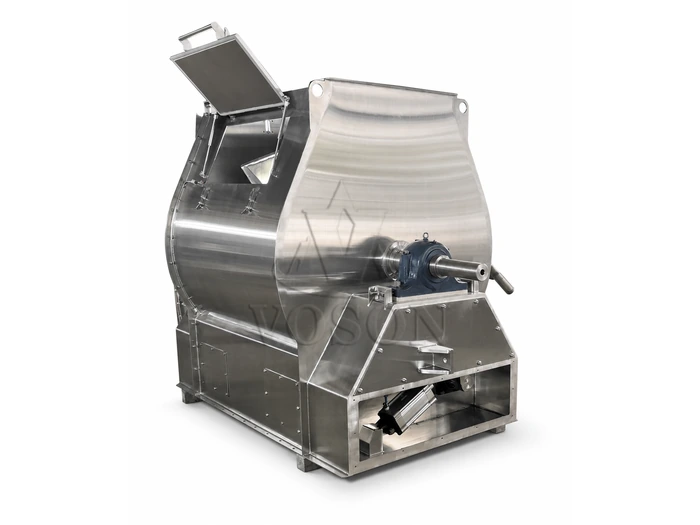
The Voson Stainless Steel Twin-Shaft Paddle Mixer is a horizontal batch mixer for flour, starch, premixes, food ingredients and other compatible powders or small granules. Two parallel shafts carry specially arranged paddles that lift, scatter and cross-mix material through the chamber. This coordinated movement supports rapid, uniform blending while limiting unnecessary compression of suitable ingredients.
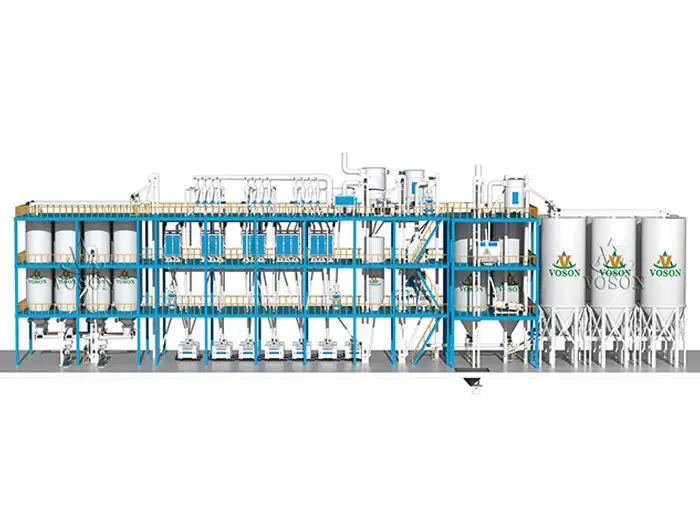
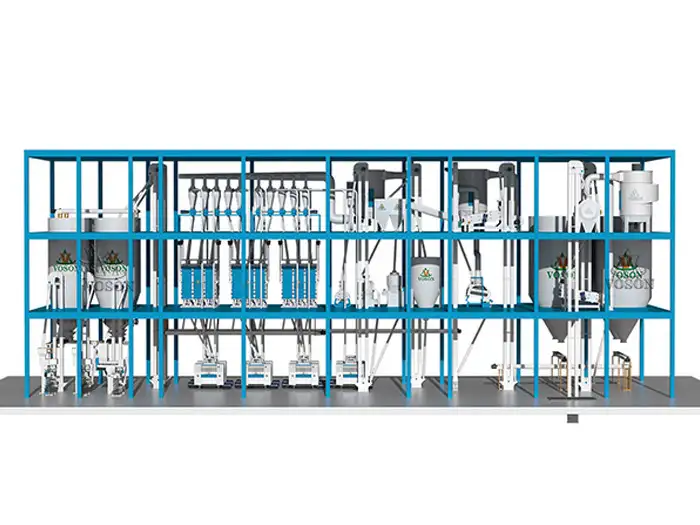
The machine can be integrated with weighing and dosing equipment, stainless steel screw conveyors, storage bins and a flour packing machine. Chamber volume, usable batch weight, paddle layout, shaft speed, discharge system and motor are selected from the material and process requirement rather than one universal specification.
Item
Available Configuration
Mixer type
Horizontal batch mixer with two parallel paddle shafts
Typical materials
Maize flour, wheat flour, starch, premixes, food powders and suitable small granules
Working capacity
Customized; confirmed from batch weight, bulk density and recommended fill level
Product-contact construction
Stainless steel; grade, thickness and surface finish confirmed before manufacture
Feeding
Manual, conveyor-fed or integrated with weighing and dosing equipment
Discharge
Large bottom outlet or other project-specific discharge arrangement
Controls
Batch timer, variable-frequency control, pneumatic functions and line interlocks as required
The table gives configuration guidance, not guaranteed model data. Final capacity, motor power, shaft speed and mixing time depend on bulk density, particle size, moisture, flowability, ingredient ratio, batch weight and the required mixing test result.
How a Twin-Shaft Paddle Mixer Works
Two shafts rotate in coordinated directions inside the horizontal chamber. Paddles mounted on both shafts pick up material from different zones and project it toward the center and opposite side. The overlapping trajectories repeatedly separate and recombine the ingredients, creating strong convective mixing with localized particle exchange.
With a suitable fill level and shaft speed, the moving material may form a low-density mixing zone in which particles can change position quickly. The result depends on the actual formulation, so the term “fluidized mixing” describes the movement principle and is not a guarantee of a fixed mixing time or uniformity value for every recipe.
After the validated mixing period, a large bottom discharge opening can release the batch quickly into a receiving hopper or downstream conveyor. Fast discharge helps shorten the total batch cycle, but the outlet size and receiving equipment must be selected to avoid restriction or material backup.
Internal Paddle and Shaft Structure
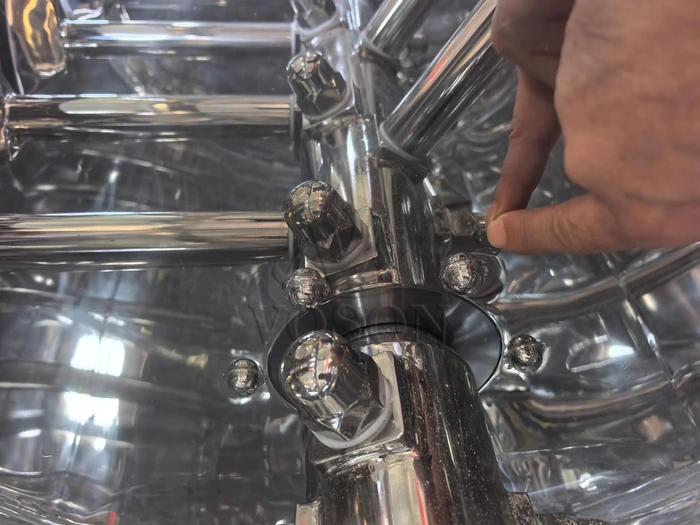
The internal detail shows the polished shaft, paddle support and bolted connection. Paddle quantity, angle, spacing and clearance influence circulation, energy demand and residue. Some configurations allow the paddle position or angle to be adjusted during commissioning; the exact construction is confirmed in the technical proposal.
Shaft seals separate the product chamber from the bearing and drive areas. Seal type must match powder fineness, operating temperature, cleaning method and any pressure or dust-control requirement. Regular inspection of paddle fasteners, shaft seals and clearances is part of routine maintenance.
Main Features
Two-shaft mixing action: Overlapping paddle paths move ingredients between both sides and the center of the chamber.
Fast batch circulation: Strong convective movement can shorten the required blending stage for suitable formulations when correctly selected.
Suitable for varied ingredients: Paddle mixing can handle many recipes containing powders or small granules with differences in particle size and bulk density.
Rapid discharge option: A large bottom opening can empty the chamber quickly and reduce material retention between batches.
Stainless steel contact surfaces: The chamber, shafts, paddles and agreed product-contact components can be manufactured in stainless steel.
Inspection and cleaning access: Large covers and access panels can support inspection, manual cleaning and maintenance under a safe lockout procedure.
Production-line integration: Dosing, weighing, conveying, packing and control equipment can be coordinated with the batch sequence.
Stainless steel construction is project-specific. Product-contact parts can be stainless steel while the motor, gearbox, bearing housings, actuator, guards and support structure may use other materials unless full stainless steel construction is stated in the quotation.
Applications in Flour and Powder Processing
Maize flour and wheat flour formulations
Starch, modified flour and cereal blends
Bakery, seasoning and food-ingredient premixes
Vitamin, mineral or functional premixes at validated addition ratios
Feed ingredients and suitable powder-granule blends
Other compatible dry or low-moisture batch formulations
Suitability must be checked before ordering. High liquid content, sticky ingredients, highly abrasive powders, fragile inclusions or very large density differences can require a different paddle design, spray system, wear protection, seal or operating sequence. Dust explosibility, allergen control and sanitation requirements also affect the electrical and mechanical specification.
Twin-Shaft Paddle Mixer vs Ribbon Mixer
Selection Point
Twin-Shaft Paddle Mixer
Horizontal Ribbon Mixer
Primary movement
Two paddle shafts lift, scatter and cross-mix material
Inner and outer ribbons circulate material axially and radially
Typical advantage
Rapid mixing and fast discharge for suitable powder or powder-granule recipes
Thorough circulation of many free-flowing dry powder batches
Material handling
Can provide relatively gentle, low-compression movement when correctly selected
Continuous ribbon movement can be effective for cohesive or uniform powder systems
Discharge
Often configured with a large bottom opening
Commonly uses a bottom or side discharge valve
Final choice
Must be based on formulation, batch size, density difference, fragility, cleaning and required test result
Neither design is universally better. Voson selects the mixer from material tests or verified material data and from the required batch cycle, cleaning procedure and downstream process.
Reference Selection Parameters
Confirmed model, capacity and motor-power data are not available for this product page. The following information is therefore used for engineering selection and must not be interpreted as fixed machine specifications.
Required Information
Selection Purpose
Material names and addition ratios
Defines the formulation and segregation risk
Bulk density and particle size
Converts batch weight to working volume and influences paddle design
Batch weight and batches per hour
Determines chamber size and required total cycle time
Moisture, oil or liquid addition
May require spray equipment, different seals or another mixer design
Fragility and allowable breakage
Influences paddle geometry and shaft speed
Target mixing result and test method
Provides the acceptance basis for mixing time and uniformity
Cleaning and allergen controls
Influences access, surface finish, seals and residue targets
Plant voltage and layout
Determines drive, controls and equipment connections
Usable batch volume is lower than the empty chamber volume. Overfilling or underfilling can change the material trajectories and reduce mixing performance, so the recommended fill level must be confirmed for the selected machine and recipe.
Frequently Asked Questions
What is a twin-shaft paddle mixer?
It is a horizontal batch mixer with two parallel shafts carrying paddles. The shafts create overlapping material paths that lift, scatter and recombine ingredients throughout the chamber.
Is it suitable for flour and premixes?
Yes, it can be selected for maize flour, wheat flour, starch, premixes and compatible food powders. The actual recipe, addition ratio and material properties must be checked first.
How quickly does it mix?
Twin-shaft paddle mixers are often selected for rapid batch circulation, but there is no universal mixing time. The cycle must be validated for the formulation, fill level, loading sequence and required test result.
Can it mix powders with granules?
Many powder-granule blends are possible. Particle size, density difference, fragility and segregation after discharge must be evaluated before confirming the machine.
Can liquid be added?
Limited liquid addition may be possible with a correctly designed spray system. Sticky or high-moisture formulations may require different paddles, seals, drive power and cleaning access.
What information is needed for a quotation?
Please provide the formulation, bulk density, particle size, moisture, batch weight, batches per hour, target mixing result, cleaning requirements, voltage and production-line layout.
Customized Paddle Mixing Equipment from Voson
Voson supplies customized stainless steel twin-shaft paddle mixers for flour, starch, premixes and suitable dry-powder processing lines. Send the material data, batch requirement and equipment layout to receive a proposal covering the mixer, feeding, discharge, conveying and packing connections.
We receive enquiries in English, Español (Spanish), Русский язык (Russian), Français (French) and العربية (Arabic). Our professional team will reply to you within one day. Please feel free to contact us!